Hazard Communication remains one of OSHA’s most frequently cited standards year after year, and even organizations with established programs can have gaps in written procedures, chemical labeling, Safety Data Sheet management, or employee training. Join CMI for a practical walkthrough to help you evaluate your program, identify potential deficiencies, and better understand what OSHA expects during an inspection.
Is Your HazCom Program OSHA-Ready?
Is Your HazCom Program OSHA-Ready?
A recording of this presentation is now available. Complete the form below to view.
"*" indicates required fields
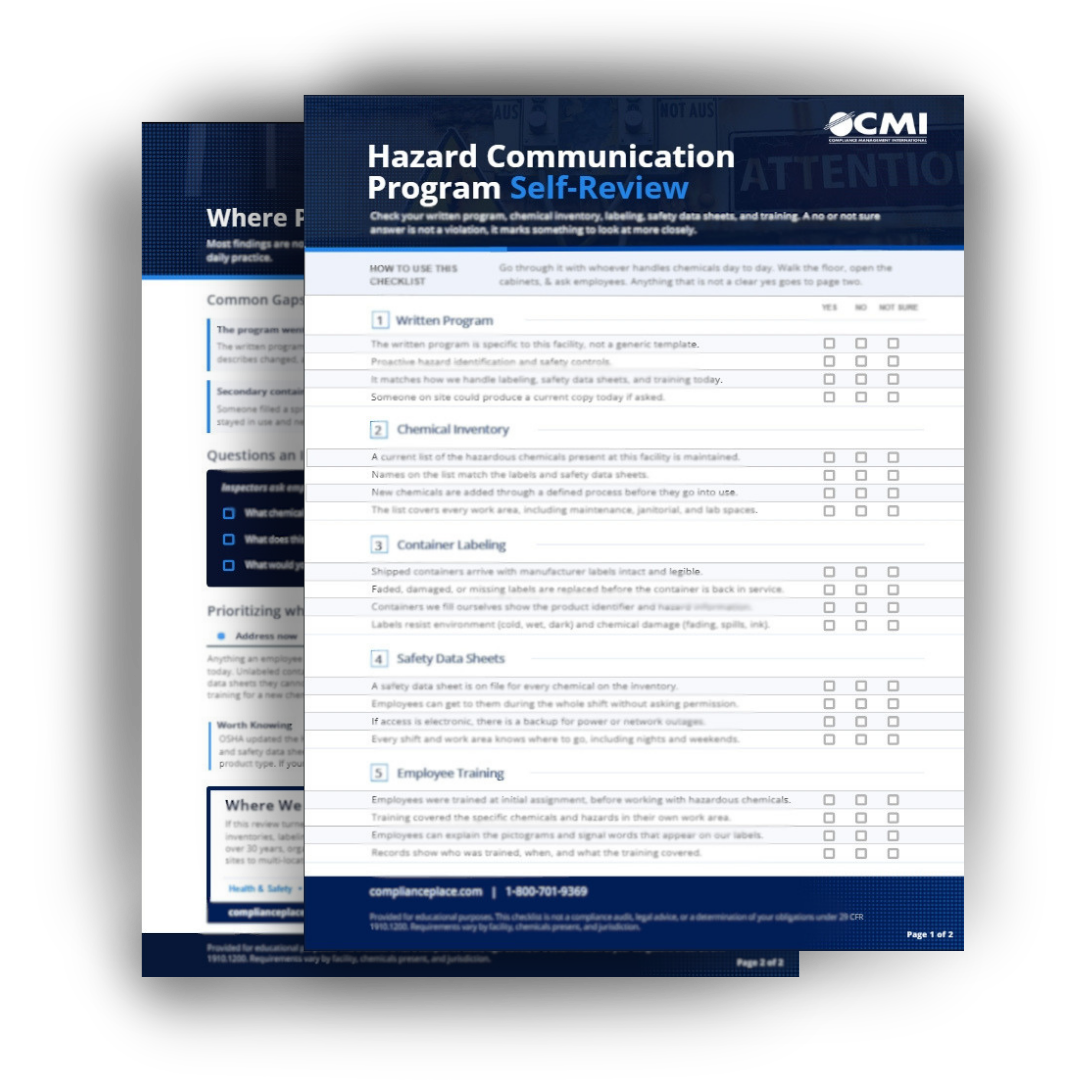
Take the Next Step: HazCom Program Self-Review
Watching the webinar is the first step. Working through your own program is where the value shows up.
Our two-page HazCom Program Self-Review Checklist turns the material from this session into something you can actually use at your facility. It walks you through the five core pillars of a Hazard Communication Program: your written program, chemical inventory, labeling, Safety Data Sheet management, and employee training.
Use it to spot gaps in your own procedures, flag what needs attention, and prioritize corrective actions before an inspector does it for you. No cost, no strings.
What We Cover
- This session walks through the key elements of an effective Hazard Communication Program and where organizations most often run into trouble.
- Why Hazard Communication continues to be one of OSHA’s most frequently cited standards.
- OSHA inspection focus areas and written program requirements.
- How to evaluate workplace chemical labeling practices.
- Safety Data Sheet management and accessibility requirements.
- Preparing employees to confidently answer OSHA inspector questions.
- Identifying corrective actions, prioritizing them, and strengthening overall compliance.
Why This Matters In 2026
- HazCom sits near the top of OSHA’s most cited standards every year.
- The updated HazCom rule aligns the standard with GHS Revision 7.
- Employer labeling and training updates for substances come due in 2026.
- Reformatted Safety Data Sheets are already arriving from chemical suppliers.
- Written programs that were never updated no longer match the workplace.
- Small labeling and SDS gaps often turn into multiple citations at once.

Rebecca Caffrey, CSP
Certified Safety Professional
Meet Your Presenter
Rebecca Caffrey is a Certified Safety Professional (CSP) who helps organizations develop, implement, and improve workplace safety programs. Her work spans hazard communication, OSHA compliance, SDS management, chemical labeling, and safety program development across manufacturing, industrial, and commercial settings.
In this session, she provides practical insight into OSHA’s Hazard Communication requirements and shares strategies organizations can use to assess their programs, reduce risk, and improve compliance performance.
Questions? Contact rcaffrey@complianceplace.com