EHS Insights
Blog Article
HazCom: What OSHA Actually Requires From Employers
Hazard Communication (HazCom): What OSHA Actually Requires From Employers
By Compliance Management International
Hazard Communication sounds like it belongs to chemical plants and laboratories. It reaches far more workplaces than that, and the compliance date for employers to update their programs for GHS Revision 7 is November 20, 2026. Here is what the standard actually requires, in plain terms.
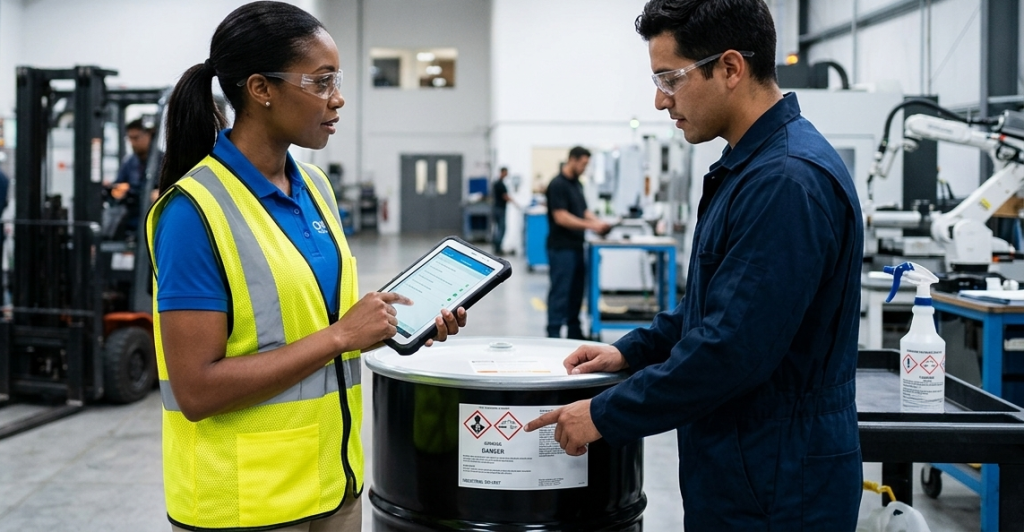
Any workplace that stores or uses hazardous chemicals falls under OSHA’s Hazard Communication standard, 29 CFR 1910.1200. That includes cleaning products, adhesives, solvents, coatings, and certain office and maintenance supplies. Most people shorten it to HazCom, and OSHA also calls it the Right-to-Know standard.
As a result, it lands on OSHA’s most frequently cited list year after year. However, that ranking does not mean employers ignore the standard. Instead, two things tend to happen. First, a workplace assumes the rule does not apply to it. Second, a program that once worked quietly drifts out of date.
The Basic Idea Behind HazCom
The standard exists on a simple premise. Employees have a right to know what chemical hazards they work around, and employers are responsible for communicating those hazards clearly.
Since 2012, HazCom has aligned with the Globally Harmonized System (GHS), an international framework that standardizes how companies classify and label chemical hazards. As a result, a label means roughly the same thing whether a domestic plant or an overseas supplier produced the product. In a supply chain that rarely stays inside one country’s borders, that consistency matters.
Then, in May 2024, OSHA updated the standard again to align with GHS Revision 7. That was the first significant change since 2012. The rule took effect on July 19, 2024, and it set staggered compliance dates. In January 2026, OSHA pushed each of those dates back by four months. Consequently, most employers now work toward one date: November 20, 2026.
The Dates and Numbers That Define a Compliant Program
Four figures drive most HazCom findings. If you only review one thing this quarter, review these.
4 Elements
Written program, container labels, Safety Data Sheets, and employee training. OSHA expects all four working together.
16 Sections
Every Safety Data Sheet follows the same 16-section format, from composition and handling to first aid and disposal.
Nov 20, 2026
Employer deadline to update workplace labels, the written program, and training for substances under GHS Revision 7.
May 19, 2028
The same employer deadline for mixtures. Manufacturers must update labels and SDSs for mixtures by November 19, 2027.
The Four Required Elements of a HazCom Program
A compliant program has four parts. OSHA generally expects to see all four functioning together, not just one or two.
1
A Written Hazard Communication Program
This document describes how your organization meets each part of the standard. Specifically, it explains how you classify chemicals, manage labels and SDSs, conduct training, and tell employees about the hazards in their own work area. In addition, it has to list every hazardous chemical currently at the worksite.
A written program that does not reflect what is actually on site is not compliant, even if it looks thorough on paper.
2
Labels on Every Container
Chemical containers need a product identifier, a signal word of either Danger or Warning, hazard statements, precautionary statements, and the relevant pictograms, consistent with the chemical’s current Safety Data Sheet.
Secondary containers count. A spray bottle filled from a bulk drum generally needs a label unless the narrow immediate-use exception applies.
3
Safety Data Sheets for Every Hazardous Chemical
Manufacturers and importers must provide an SDS for each hazardous chemical, formatted into 16 standardized sections. Employers are then responsible for maintaining an SDS for every hazardous chemical on site.
Readily accessible means employees can reach it during their shift without asking permission or going searching for it.
4
Employee Training
Training has two components, and employers often blur them together. First, general information about the standard covers how to read a label, how an SDS organizes its 16 sections, and what rights employees have. Second, hazard-specific training ties to the actual chemicals in an employee’s work area.
Training is required before an employee first works with a hazardous chemical, and again whenever a new hazard is introduced. It is not only an annual event.
Who HazCom Actually Applies To
HazCom is not limited to obviously chemical-heavy operations. If a workplace has hazardous chemicals present, even in modest quantities, the standard applies.
Clearest Fit
- Manufacturing and industrial facilities
- Chemical processing and blending
- Laboratories and testing facilities
- Warehousing and distribution
Often Overlooked
- Construction and contracting
- Facilities and building maintenance
- Printing and coating operations
- Auto repair and fleet shops
Surprises People
- Food service and food processing
- Healthcare and long-term care
- Data centers and utility spaces
- Offices with cleaning concentrates on hand
The mismatch between how chemical-heavy a workplace feels and whether HazCom actually applies is one of the more common reasons gaps go unnoticed until an inspection.
Where HazCom Programs Tend to Drift
Most HazCom problems are not the result of an employer ignoring the standard outright. Typically, they are the result of a program that was compliant when it was built and then did not keep pace with the workplace.
For example, purchasing brings in a new chemical and no one adds an SDS or an inventory entry. A secondary container loses its label. An SDS system technically exists, but nobody on the floor can reach it quickly. Meanwhile, training covers the standard in general terms and never connects to the chemicals an employee actually handles.
The GHS Revision 7 update adds a version of the same problem. You do not need to rebuild a written program that already meets the requirements. However, you do need to review anything tied to the 2012 alignment, check the revised definitions, and confirm the hazards for the chemicals you use. Ultimately, none of this calls for an overhaul. It calls for someone checking the written program against what actually happens day to day
Self-Review Checklist
Common Gaps
- Chemical inventory out of date
- Missing or outdated SDSs
- Unlabeled secondary containers
- Training with no hazard-specific component
- Written program not reviewed since 2012
Non-Negotiables
- SDSs accessible during every shift without asking
- Labels consistent with the current SDS
- Training completed before first use of a chemical
In Summary
The Bottom Line
HazCom is built around a straightforward goal. Make sure the people working around hazardous chemicals know what those hazards are and how to respond to them.
The mechanics exist to make that knowledge available at the moment it is actually needed, not buried in a binder or a database no one can reach quickly. A program that is technically documented but practically inaccessible fails that goal even if it looks complete on paper.
HazCom Questions We Get Most Often
Tap any question to expand the answer.
Does the HazCom standard apply to my workplace?
If hazardous chemicals are present, yes. The standard is not limited to chemical plants or laboratories. Cleaning concentrates, solvents, adhesives, coatings, and maintenance supplies all count. Quantity does not exempt a workplace.
What are the four required elements of a HazCom program?
A written hazard communication program that includes a current list of hazardous chemicals on site, labels on every container, a Safety Data Sheet for every hazardous chemical, and employee training. OSHA generally expects all four working together.
When do employers have to comply with the GHS Revision 7 update?
November 20, 2026 for substances. Employers must update alternative workplace labeling, update the written hazard communication program, and provide additional training for newly identified hazards by that date. The corresponding date for mixtures is May 19, 2028. These dates reflect the four-month extension OSHA issued in January 2026.
Does our existing written program need to be replaced?
Not necessarily. If a program already meets the requirements, you can update it instead of rebuilding it. However, you still need to review anything tied to the 2012 alignment, the revised definitions in the 2024 rule, and any hazards newly identified for your chemicals.
Do secondary containers like spray bottles need labels?
Generally yes. A container filled from a bulk drum needs to communicate the same hazard information. A narrow exception applies for immediate use by the same person during the same shift, but relying on it as a routine practice is where facilities get cited.
How often is HazCom training required?
Train employees before they first work with a hazardous chemical, then again whenever a new chemical hazard enters the work area. In short, workplace change drives the requirement, not a fixed annual schedule. That said, many employers refresh annually as a matter of practice.
Can we keep Safety Data Sheets in a binder or online only?
Either can work as long as employees have ready access during their work shift without asking permission. An electronic system needs a reliable backup for power or network outages, and employees need to know how to use it.
Hazard Communication Resources
Need Help Building or Reviewing a HazCom Program?
Compliance Management International develops and evaluates Hazard Communication programs, builds and maintains chemical inventories and SDS systems, and delivers employee HazCom training. If you need help getting a program current before the November 2026 compliance date, our team can help.